
Aeronep Policy Insight
Foreign Direct Investment in Nepal
Nepal is gradually opening its economy to outside capital, and Aeronep Consulting Services helps investors move through every stage of that journey, from choosing the right route under Nepal's investment law to receiving final clearance from the central bank.
- Governing law
- FITTA 2019
- Approval stages
- 3 Stages
- Typical approval time
- 1–2 Months
Governing investment law
DOI/IBN, OCR, NRB
For straightforward filings

Understanding Foreign Direct Investment in Nepal
Foreign Direct Investment in Nepal describes the process through which an investor based outside the country puts capital directly into a Nepali business, rather than buying shares through a public market. That capital can fund a brand new company, expand an existing one, or support a joint venture with a local partner. For a country still building out its industrial base, this kind of investment carries real weight: it brings in foreign currency, introduces new skills and technology, and opens sectors that need large amounts of capital to grow.
Aeronep Consulting Services, based in Jwagal, Kupondole, Lalitpur, works with investors at every stage of this process. The firm's team of corporate lawyers, chartered accountants, and compliance specialists has built its practice around helping entrepreneurs and companies understand Nepal's legal, financial, and regulatory requirements, and Foreign Direct Investment in Nepal sits at the center of that work. You can read more about the firm's founding and outlook on its story and vision page.
This guide walks through what Foreign Direct Investment in Nepal actually involves, where the country's FDI numbers stand today, how the approval process works under current law, and what challenges investors should plan around before committing capital.
What is Foreign Direct Investment in Nepal?
In simple terms, Foreign Direct Investment in Nepal is capital that a foreign individual, company, or institution commits directly to a Nepali enterprise, with an active stake in how that business is run. This sets it apart from portfolio investment, where a foreign party simply buys and sells shares without any operational involvement.
Every foreign investment of this kind is governed by the Foreign Investment and Technology Transfer Act, 2019, generally referred to as FITTA. This law sets out who can invest, how much capital is required, which government bodies must approve the investment, and how profits can eventually be sent back out of the country.
Direct Ownership
Capital goes straight into a company's ownership or operations, not into buying shares on a stock exchange.
Law-Governed
FITTA 2019 sets the legal boundaries for eligibility, approval, and repatriation of profit.
Multi-Agency Approval
Three separate government bodies review and clear an investment before it becomes operational.
Sector-Specific
Rules and routes to approval vary by industry, with some sectors moving faster than others.
Important Laws Governing Foreign Direct Investment in Nepal
- Foreign Investment and Technology Transfer Act, 2019
- Industrial Enterprise Act, 2020
- Company Act, 2006
- Public Private Partnership and Investment Act, 2019
- Income Tax Act, 2002
- Foreign Investment and Technology Transfer Regulation, 2021
Why Foreign Direct Investment Matters for Nepal
Our mission centers on building an entrepreneurial Nepal, one where businesses create jobs and drive the economy forward rather than depending on outside aid. Foreign Direct Investment plays directly into that goal by bringing resources into the country that domestic capital alone cannot always provide.
Job Creation
New foreign-backed businesses need local staff, which supports Aeronep's broader mission of building jobs through entrepreneurship rather than dependency.
Capital for Priority Sectors
Hydropower, tourism, and renewable energy projects often require more capital than domestic investors can supply on their own.
Stronger Economic Base
We views entrepreneurship, foreign-backed and domestic alike, as the foundation of national trade strength and long-term prosperity.
Formal Compliance Culture
Every foreign-invested company must register and report through official channels, which strengthens Nepal's regulatory and tax base over time.
Access to Expertise
Foreign investors frequently bring management practices and technical know-how that transfer to local teams and partners.
A More Competitive Nepal
Aeronep's policy work argues that reducing barriers to investment makes Nepal more competitive against other economies in the region.
Key Government Bodies Involved in Foreign Investment in Nepal
Ministry of Industry, Commerce and Supplies
Formulates policies and laws related to foreign investment and industrial development.
Industry and Investment Promotion Board
Provides consent and approval for industries that require special permissions.
Investment Board of Nepal (IBN)
Facilitates and approves major foreign investment projects, particularly investments above NPR 6 billion, along with other investment-related facilities.
Department of Industry (One Stop Service Center)
Handles foreign investment below NPR 6 billion.
Provides industry registration, investment approval, and other administrative services through the One Stop Service Center.
Office of Company Registrar (OCR)
Registers companies in Nepal.
Handles company administration, filings, and related corporate services.
Nepal Rastra Bank (NRB)
Facilitates approval for bringing foreign currency into Nepal against approved foreign investment.
Oversees foreign investment accounting and repatriation of investment and returns.
Current Status of Foreign Direct Investment in Nepal
According to Aeronep Consulting's review of the investment landscape, total Foreign Direct Investment in Nepal reached approximately USD 180 million in the most recent financial year covered by the firm's analysis, a modest increase over the year before. That figure still sits below what many neighboring economies attract, which points to room for growth rather than a market that has plateaued.
The sectors currently drawing the most foreign capital include hydro-electricity generation, hospitality and tourism, general industry, and food production. Hydropower in particular stands out as an area of significant scope for further investment, tourism continues to be a key contributor to the country's economic activity, and manufacturing is aiming for improved output and product quality. Authorities are actively working to strengthen the overall business environment so that additional foreign capital keeps flowing into these industries.
~USD 180M
Approximate total FDI, most recent financial year reviewed
- Hydropower: significant scope
- Tourism: key driver of activity
- Industry: aiming for better output
- Food production: growing interest
Foreign Direct Investment in Nepal's Construction Sector
Investors looking at property and construction projects in Nepal need to confirm early on that their specific sector qualifies for foreign investment, since not every category of real estate or building activity is treated the same way under current rules. Aeronep's advisory work on the FDI approval process flags this as one of the more common points of confusion for first-time investors, alongside hospitality projects that carry their own licensing steps.
Land acquisition is another recurring difficulty in this sector. Aeronep's broader review of Nepal's investment climate lists land procurement, together with related judicial system concerns, as one of the factors that regularly slows down construction-related investment. Part of the firm's policy recommendations calls for reform of property acquisition processes as a way to make this sector easier for foreign capital to enter.
Nepal FDI Policy and Legal Framework
Nepal's FDI policy is set out primarily through the Foreign Investment and Technology Transfer Act, 2019 (FITTA). This law replaced the country's older investment framework and gives investors a clearer, more structured path into the market. It defines the minimum capital an investor must bring in, sets out which government body reviews which size of project, and establishes the role Nepal Rastra Bank plays in confirming that capital and, eventually, allowing profit to be sent back abroad.
Under FITTA, certain sectors are placed on a restricted or "negative" list and are not open to foreign capital, while other sectors qualify for a faster automatic route that skips the standard case-by-case review. Aeronep advises investors to confirm where their sector falls before committing time and resources to an application.
Eligibility at a Glance
- General minimum investment threshold: NPR 20 million under FITTA.
- IT and software businesses are exempt from this minimum when applying through the automatic route.
- Renewable energy, warehousing, and web-based service businesses also qualify for the automatic route.
- Sectors on Nepal's negative list are not open to foreign capital and should be ruled out before filing.
Foreign Investment Approval Process: Step by Step
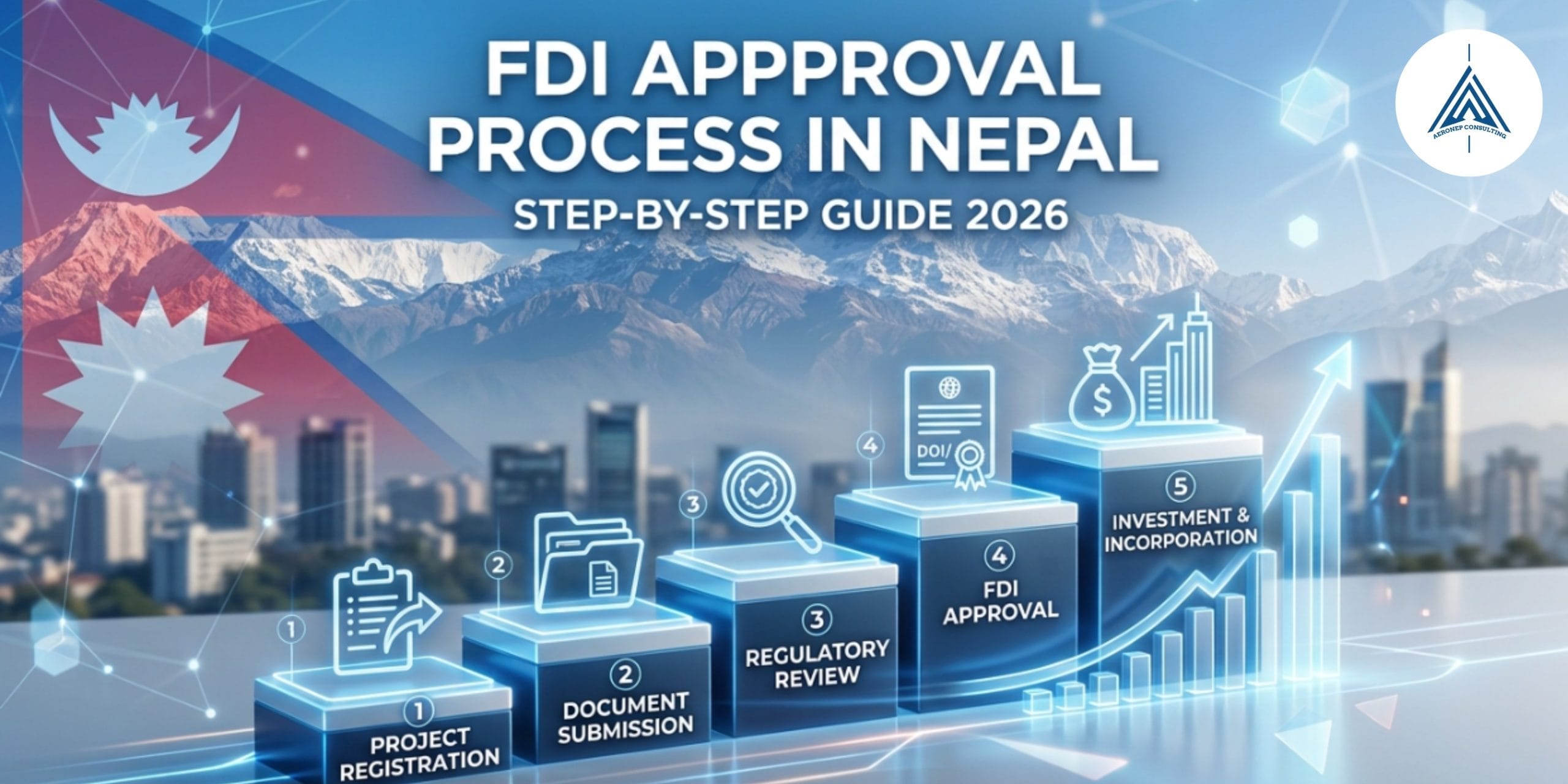
The FDI Approval Process in Nepal moves through three government bodies in a fixed order. Each stage depends on the one before it, which means an investor cannot register a company before receiving preliminary approval, or bring in capital before that company exists. Most straightforward applications clear all three stages within one to two months, though larger or more complex projects, or filings with missing documentation, tend to take longer.
- 1
Preliminary Approval from DOI or IBN
The Department of Industry generally handles investment proposals up to NPR 6 billion, while the Investment Board of Nepal reviews larger scale projects above that mark. At this stage the investor submits a detailed project report, a company profile, and proof of financial credibility.
- 2
Company Incorporation at the Company Registrar
Once preliminary approval is granted, the business is formally incorporated at the Office of the Company Registrar under Nepali law, using the approval letter, the memorandum and articles of association, and identification for all shareholders and directors.
- 3
Final Approval from Nepal Rastra Bank
The investor transfers the approved capital into Nepal through a licensed commercial bank. Nepal Rastra Bank reviews the transaction, confirms it matches the approved amount, and issues final approval, which also sets the foundation for future profit repatriation.
Typical timeline
1–2 Months
Applies to straightforward filings with complete documentation. Larger investment amounts or incomplete paperwork extend this window.
Documents Required for Foreign Investment Approval
Stage 1 · DOI / IBN
- Detailed project report
- Company profile
- Proof of financial credibility
Stage 2 · Company Registrar
- Preliminary approval letter
- Memorandum and articles of association
- Identification for shareholders and directors
Stage 3 · Nepal Rastra Bank
- Proof of capital transfer via a licensed commercial bank
- Confirmation the amount matches approved capital
Challenges and Prospects of Foreign Direct Investment in Nepal
Where investors run into friction
- Political and governmental instability that affects long-term planning
- Bureaucratic procedures that can be lengthy and intricate
- Infrastructure shortfalls, particularly in logistics
- Land acquisition difficulties and related judicial concerns
- Limited access to capital for domestic partners
- Currency fluctuation risk over the life of an investment
- Incomplete financial documentation, the most frequent cause of approval delays
How Aeronep advises investors to respond
- Complete thorough due diligence before committing capital
- Consider political risk insurance for larger commitments
- Partner with established local firms who know the terrain
- Diversify investment across more than one sector where possible
- Prepare complete documentation before submission to avoid delay
- Confirm sector eligibility against the negative list early
Aeronep's own policy recommendations call for reform of property acquisition processes, a reduction in certain business charges, and stronger incentives for priority industries such as energy, tourism, and agribusiness. The firm views these reforms as key to improving Nepal's competitiveness for international investors over time.
Why Investors Choose Aeronep Consulting Services for FDI
Aeronep Consulting Services was founded in Kathmandu on 10 Falgun 2079 with a stated commitment to building an entrepreneurial Nepal, and the firm's guidance on Foreign Direct Investment grows directly out of that mission. Because the FDI Approval Process touches legal, financial, and regulatory requirements at the same time, Aeronep manages the entire journey under one roof, from the initial DOI or IBN filing through company registration and Nepal Rastra Bank clearance.
The firm's team includes Adv. Jeevan K. Shahi, CEO and corporate lawyer, and CA Saroj Dahal, partner and chartered accountant, supported by legal, compliance, and research staff who work across corporate legal, corporate financial, licensing and regulatory, and entrepreneurship support services. You can meet the full team on the Aeronep team page.
Support does not stop at final approval. Aeronep also assists investors with tax registration, ongoing compliance, and financial reporting once the business becomes operational, so the transition into active operations stays smooth from day one.
One-Stop FDI Consulting
Corporate lawyers and chartered accountants working together under a single engagement.
Local Expertise
A deep, current understanding of Nepal's legal and business environment.
End-to-End Guidance
Support from initial filing through Nepal Rastra Bank clearance and beyond.
Post-Approval Support
Tax registration, compliance, and financial reporting once operations begin.
Ready to Invest in Nepal?
Reach out to Aeronep Consulting Services and the team will map out the exact steps for your specific sector and investment size, from preliminary approval to final Nepal Rastra Bank clearance.
Frequently Asked Questions
What is Foreign Direct Investment in Nepal?
Foreign Direct Investment in Nepal is capital that a foreign investor commits directly into a Nepali business, with an active role in its ownership or operations, rather than simply buying shares on a public market. It is governed by the Foreign Investment and Technology Transfer Act, 2019.
What is Nepal's FDI policy?
Nepal's FDI policy runs through FITTA 2019, which sets a general minimum investment of NPR 20 million, defines which sectors qualify for a faster automatic route, and lists sectors that remain closed to foreign capital under a negative list.
What is the investment approval process in Nepal?
The process runs through three stages: preliminary approval from the Department of Industry or the Investment Board of Nepal, company incorporation at the Office of the Company Registrar, and final approval from Nepal Rastra Bank once capital enters through a licensed bank. Straightforward applications typically clear within one to two months.
Can foreign investors invest in Nepal's construction sector?
Yes, though investors should confirm their specific sector qualifies for foreign investment before filing, since not all construction or real estate categories are treated the same way. Land acquisition is also a common point of friction in this sector.
Who qualifies as a foreign investor under Nepal's FDI rules?
A foreign investor generally needs a minimum investment of NPR 20 million under FITTA, though IT and software businesses are exempt from this threshold when applying through the automatic route, alongside renewable energy, warehousing, and web-based service businesses.
Moving Forward With Foreign Direct Investment in Nepal
Foreign Direct Investment in Nepal is still a developing story. The country offers real opportunity in hydropower, tourism, manufacturing, and renewable energy, but investors who succeed tend to be the ones who plan carefully around FITTA 2019, prepare complete documentation from the start, and understand which government body handles which part of the approval chain.
Aeronep Consulting Services was built to stand beside those investors and the wider community of entrepreneurs shaping Nepal's economy. Whether you are weighing your first project or expanding an existing one, the firm's team can walk you through eligibility, documentation, and every stage of approval from a single point of contact. Get in touch with Aeronep Consulting Services to start the conversation.