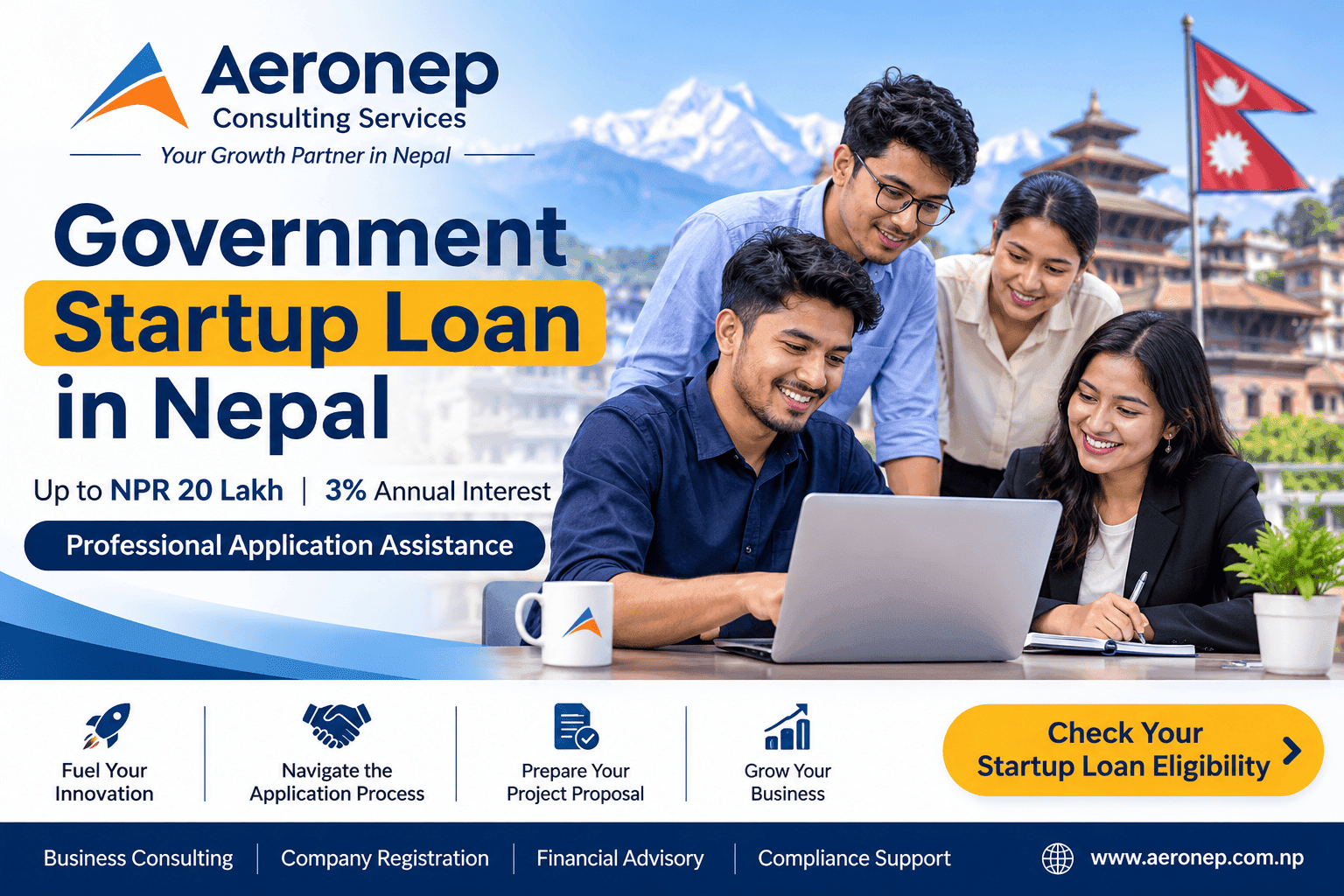
Are you planning to start a business or expand an innovative enterprise in Nepal? The Government of Nepal offers concessional financing opportunities to eligible startups through its Startup Enterprise Loan Programme. This initiative aims to encourage innovation, promote entrepreneurship and support businesses with high growth potential.
However, obtaining a startup loan involves more than having a promising business idea. Applicants must meet the prescribed eligibility criteria, prepare a viable project proposal, demonstrate the potential of their business and submit the required financial and legal documents.
Aeronep Consulting Services (ACS) provides professional assistance to entrepreneurs seeking concessional startup loans in Nepal. We help businesses assess their eligibility, organise documentation, develop business and financial plans, and prepare comprehensive startup loan proposals.
Whether you are establishing a new enterprise or operating an innovative business, our team can help you navigate the application process with greater clarity and confidence.
Contact Aeronep Consulting Services to discuss your startup financing requirements.
What Is the Concessional Startup Loan Programme in Nepal?
The Concessional Startup Loan Programme, also known as the Startup Enterprise Loan Programme (स्टार्टअप उद्यम कर्जा कार्यक्रम), is a government initiative designed to provide affordable financing to eligible innovative businesses in Nepal.
The programme is administered by the Ministry of Industry, Commerce and Supplies and implemented through the Industrial Enterprise Development Institute (IEDI), in coordination with designated banks.
The programme operates under the Startup Enterprise Loan Programme Operation Procedure, 2082, including its subsequent first amendment.
Unlike ordinary commercial loans, this programme offers financing at a prescribed concessional interest rate. It aims to help startups develop products and services, adopt technology, improve business operations, generate employment and contribute to Nepal’s economic development.
The programme is particularly relevant to entrepreneurs who have innovative business models, technology-driven solutions, locally developed products or services, and the potential to expand their operations.
Key Features of the Government Startup Loan in Nepal
The following are the principal financing provisions under the Startup Enterprise Loan Programme, 2082:
| Particulars | Programme provisions |
|---|---|
| Minimum loan amount | NPR 5 lakh |
| Maximum loan amount | NPR 20 lakh |
| Annual interest rate | 3% |
| Maximum repayment period | 5 years |
| Repayment commencement | After the prescribed initial grace period of up to one year from the first loan disbursement |
| Implementing institution | Industrial Enterprise Development Institute (IEDI) |
| Lending institutions | Banks designated under the programme |
The actual loan amount depends on the project proposal, its evaluation and the applicable programme requirements. Applicants should not assume that they will automatically receive the maximum amount.
The bank may also charge an administrative or service fee of up to 0.15% of the loan amount, as permitted by the procedure.
These terms are subject to the applicable government procedure, amendments and programme notices.
Who Is Eligible for a Concessional Startup Loan in Nepal?
Not every newly established business automatically qualifies as a startup under the government programme.
To qualify, an enterprise must meet the prescribed eligibility requirements.
Generally, an eligible enterprise must satisfy the following conditions:
1. Registered Business or Enterprise
The applicant must be a registered private firm, partnership firm, company or cooperative registered with the relevant authority as an industry under prevailing laws.
An unregistered business cannot qualify merely because it has an innovative business idea.
2. Innovation and Creativity
The business must use innovative or creative ideas in developing, producing, operating or distributing products, services or business processes.
The enterprise should demonstrate how its products, services or operating methods introduce improvements or provide solutions to existing problems.
3. Use of Technology
The enterprise must demonstrate the adoption of technology in its business activities.
Technology adoption may involve digital platforms, software, automated systems, modern production methods, technological improvements or other relevant applications.
4. Business Registration Period
The enterprise must not have exceeded ten years from its date of registration.
The relevant registration date and eligibility cut-off will be assessed according to the applicable programme notice.
5. Annual Business Turnover
The enterprise must not have exceeded NPR 15 crore in annual turnover in any financial year since its registration.
Applicants should maintain proper financial records to establish compliance with this requirement.
6. Independent Business Operations
The enterprise must not have been created by simply dividing or merging existing businesses to obtain startup loan eligibility.
It must represent a genuinely new business venture.
7. Submission of Required Documents
Applicants must submit the prescribed project proposal and supporting documents within the application period announced by the implementing institution.
Businesses That May Not Qualify for the Startup Loan
The government procedure excludes certain businesses from the programme.
An enterprise may be ineligible if:
- It is not registered as an industry under the applicable laws.
- It primarily imports goods or services from abroad for resale or distribution.
- It or its relevant entrepreneur is blacklisted under the applicable credit information system.
- It was registered after the application notice was published.
- It is registered as a holding or investment company under the Industrial Enterprises Act.
- The applicant has previously received a concessional loan or startup enterprise loan from another institution covered by the programme restrictions.
Meeting the basic eligibility conditions does not guarantee loan approval. Each application is subject to the prescribed evaluation and approval process.
Priority Sectors for Concessional Startup Financing
The government startup loan programme covers several sectors to encourage innovation and enterprise development across Nepal.
The recognised sectors include:
1. Agriculture, Forestry and Production
Businesses introducing innovative approaches to agriculture, livestock, forestry, food processing, manufacturing and other production activities.
Examples include:
- Agricultural technology and smart farming.
- Commercial farming and modern livestock management.
- Innovative food processing and packaging.
- Agricultural supply-chain solutions.
- Sustainable production and resource utilisation.
2. Information Technology and Digital Innovation
Technology-based businesses developing digital products, services and solutions.
Examples include:
- Software and application development.
- Digital platforms and technology services.
- Artificial intelligence and automation solutions.
- Digital payment and financial technology.
- Innovative technology-based business models.
3. Infrastructure and Transportation
Enterprises introducing innovative solutions in infrastructure development, logistics, transportation and related services.
Examples include:
- Smart transportation solutions.
- Logistics and supply-chain technology.
- Innovative infrastructure services.
- Technology-based mobility solutions.
4. Social Services and Tourism
Businesses developing innovative solutions in healthcare, education, tourism and other social services.
Examples include:
- Digital healthcare and telemedicine.
- Innovative education and learning platforms.
- Sustainable tourism initiatives.
- Technology-based social services.
- Solutions improving access to essential services.
5. Traditional Industries and Local Resources
Enterprises that utilise Nepal’s traditional knowledge, skills, natural resources and locally available materials to develop commercially viable products and services.
Examples include:
- Traditional handicrafts and local industries.
- Processing of locally available raw materials.
- Innovative products based on indigenous knowledge.
- Sustainable utilisation of local resources.
- Value-added products for domestic and international markets.
The eligibility of a specific business depends on the applicable sector classification and evaluation criteria.
Documents Required for a Startup Loan Application in Nepal
Preparing complete and accurate documentation is an important part of the startup loan application process.
Under the prescribed procedure, applicants are generally required to submit the following documents:
Business Registration and Legal Documents
- Business or industry registration certificate.
- Business renewal certificate, where applicable.
- Permanent Account Number (PAN) registration certificate.
- Citizenship certificate of the authorised representative.
- Other relevant legal and regulatory documents, where required.
Financial Documents
- Tax clearance certificate for the previous financial year.
- Previous financial year’s audited financial statements.
- Details of annual business turnover.
- Financial statements and supporting records.
- Details of existing investments and financial obligations.
Business and Project Documents
- Prescribed startup loan project proposal.
- Detailed business plan.
- Description of the innovative product, service or process.
- Explanation of technology adoption.
- Estimated project investment and financing requirements.
- Revenue and expenditure projections.
- Employment generation plan.
- Implementation timeline.
- Relevant supporting evidence.
Other Supporting Documents
- Annual salary and wage details of employees for the previous financial year.
- Evidence or self-declaration regarding innovation and technology adoption.
- Other documents specified in the latest application notice.
The exact documentation requirements should always be checked against the latest official notice and prescribed application format.
How to Apply for a Government Startup Loan in Nepal
The application process involves several stages, from checking eligibility to obtaining the loan through a designated bank.
Step 1: Check Your Eligibility
First, determine whether your business meets the prescribed startup criteria.
Step 2: Prepare Your Business Plan
Develop a comprehensive business plan explaining the business model, products or services, target market, competitive advantage, revenue model and growth potential.
A strong business plan should clearly demonstrate why the enterprise qualifies as an innovative startup.
Step 3: Prepare Financial Projections
These may include:
- Projected income and expenditure.
- Cash flow projections.
- Estimated investment requirements.
- Working capital requirements.
- Revenue forecasts.
- Profitability analysis.
- Loan repayment capacity.
All financial projections should be supported by reasonable assumptions.
Step 4: Prepare the Startup Loan Project Proposal
Prepare the project proposal using the prescribed government format.
The proposal should explain the business concept, innovation, technology adoption, market opportunity, investment requirements, implementation strategy and expected outcomes.
Step 5: Submit the Application
Submit the completed application and supporting documents through the prescribed channel within the deadline announced by the Industrial Enterprise Development Institute.
Applications should follow the latest official notice and submission instructions.
Step 6: Participate in the Evaluation Process
The implementing institution evaluates applications against the prescribed eligibility and assessment criteria.
Eligible applicants may be required to present their business proposals before the evaluation committee.
The assessment considers factors such as:
- Current business operations.
- Potential for business growth.
- Adoption of technology.
- Source of raw materials.
- Financial viability.
- Employment generation.
- Quality of the business proposal and presentation.
Step 7: Loan Recommendation and Bank Assessment
Applications recommended for financing proceed through the applicable bank-level assessment and loan agreement process.
The designated bank undertakes the relevant credit assessment and documentation before disbursement.
Step 8: Loan Disbursement and Repayment
Once the necessary approval and agreement requirements are fulfilled, the bank disburses the approved loan amount.
The borrower must use the loan for the approved business purpose and repay the principal and interest according to the agreed schedule.
Important: The government programme does not guarantee loan approval. Final financing depends on eligibility, proposal evaluation, available programme funds and the applicable bank assessment.
How Aeronep Consulting Services Helps You Obtain a Startup Loan
Applying for a government startup loan requires a combination of legal compliance, financial documentation, business planning and a clear understanding of the programme requirements.
Aeronep Consulting Services provides professional startup loan application and advisory support to help entrepreneurs prepare their applications systematically.
Our services cover the following areas:
1. Startup Loan Eligibility Assessment
We review your business profile and assess whether it meets the prescribed eligibility requirements.
Our assessment covers:
- Business registration and legal status.
- Registration date and business turnover.
- Industry classification.
- Innovation and technology adoption.
- Applicable sector requirements.
- Potential eligibility concerns.
This helps entrepreneurs identify documentation gaps and possible compliance issues before preparing their applications.
2. Business Registration and Compliance Support
A business must satisfy the applicable registration and regulatory requirements to qualify for the programme.
Aeronep assists with:
- Company registration in Nepal.
- Industry registration guidance.
- Business registration updates.
- PAN and tax-related documentation.
- Regulatory compliance support.
- Preparation and review of corporate documents.
For entrepreneurs who have not yet established their businesses, we can help them understand the registration requirements before proceeding with the loan application.
3. Business Plan and Project Proposal Preparation
A well-structured project proposal is essential for presenting your business idea effectively.
We assist in preparing project proposals that clearly explain:
- Business background and objectives.
- Products or services.
- Innovative features.
- Technology adoption.
- Market demand and target customers.
- Business model and revenue generation.
- Operational and implementation plans.
- Growth opportunities.
- Employment generation.
- Project sustainability.
Our objective is to present your business in a clear, structured and commercially meaningful manner.
4. Financial Projections and Documentation
Financial viability is an important consideration in startup financing.
Our financial documentation services include:
- Project cost estimation.
- Investment requirement analysis.
- Working capital assessment.
- Projected income statements.
- Cash flow projections.
- Profitability analysis.
- Financial assumptions and supporting schedules.
- Loan repayment capacity assessment.
We aim to ensure that the financial information is consistent, realistic and properly supported.
5. Accounting, Auditing and Tax Documentation
Incomplete or inconsistent financial records can create difficulties during the application process.
Aeronep provides support with financial documentation, accounting-related requirements, audit coordination and tax compliance.
Our assistance helps businesses organise their financial records and prepare the relevant supporting documents.
6. Application Documentation and Review
Before submission, we help review the project proposal and supporting documents for completeness and consistency.
Our review focuses on:
- Compliance with the prescribed requirements.
- Accuracy of business information.
- Consistency of financial figures.
- Completeness of supporting documents.
- Clarity of the project proposal.
- Alignment with the applicable evaluation criteria.
7. Application and Presentation Guidance
Where required, we help entrepreneurs understand the application submission process and prepare for business proposal presentations.
We provide guidance on communicating the business concept, explaining financial projections, demonstrating innovation and responding to relevant questions.
Our role is to help you present your business professionally and confidently.
Why Choose Aeronep Consulting Services for Startup Loan Assistance?
Obtaining startup financing requires more than preparing a project proposal. It requires a coordinated understanding of business registration, corporate compliance, taxation, financial management and project planning.
Integrated Legal and Financial Support
We understand the importance of both legal compliance and financial documentation. Our services help entrepreneurs address these requirements in a coordinated manner.
Comprehensive Documentation Assistance
From business registration documents to financial projections and project proposals, we help organise the information required for a complete application.
Business-Oriented Approach
We focus on understanding the actual business model, investment requirements and growth potential rather than preparing generic project proposals.
Support for New and Existing Enterprises
We assist entrepreneurs who are planning to establish a business as well as existing enterprises seeking to explore government-supported startup financing.
Practical Guidance Throughout the Process
Frequently Asked Questions About Concessional Startup Loans in Nepal
1. How much startup loan can I get in Nepal?
Under the Startup Enterprise Loan Programme Operation Procedure, 2082, the prescribed loan amount ranges from NPR 5 lakh to NPR 20 lakh. The approved amount depends on the project assessment and applicable requirements.
2. What is the interest rate of the government startup loan in Nepal?
The prescribed annual interest rate under the 2082 procedure is 3%.
3. Who is eligible for a concessional startup loan in Nepal?
Eligible applicants generally include registered private firms, partnership firms, companies and cooperatives registered as industries. The enterprise must satisfy the innovation, technology adoption, registration period, turnover and other eligibility requirements.
4. Can a newly registered company apply for a startup loan?
A newly registered company may qualify if it meets the prescribed requirements. However, an enterprise registered after the publication of the relevant application notice is not eligible for that particular application round.
5. Can an existing company apply for a government startup loan?
Yes. An existing company may apply if it meets the prescribed startup criteria, including the ten-year registration limit, turnover ceiling, innovation and technology adoption requirements.
6. Is collateral required for the startup loan in Nepal?
Applicants should not assume that the programme is automatically collateral-free. The applicable procedure, credit assessment, loan agreement and bank requirements determine the relevant security arrangements.
7. What is the repayment period for the startup loan?
The maximum repayment period is five years. Repayment of principal and interest must begin according to the applicable agreement, with the prescribed initial grace period.
8. Can a business in the agriculture sector apply?
Yes. Agriculture, forestry and production-related enterprises are among the recognised sectors. The business must still satisfy the general startup eligibility requirements and the applicable sector-specific assessment criteria.
9. Can I apply for a startup loan without registering my company?
No. The enterprise must be registered with the relevant authority as an industry under the applicable laws before applying.
10. Can Aeronep Consulting Services guarantee startup loan approval?
No. Aeronep provides professional advisory, documentation and application preparation services. Loan approval is determined by the relevant government implementing institution and designated bank under the applicable procedure.
11. When can I apply for the government startup loan?
The implementing institution announces application opportunities through official notices. Applicants should monitor announcements from the Ministry of Industry, Commerce and Supplies and the Industrial Enterprise Development Institute. The application deadline and submission requirements may vary between rounds.
12. Can Aeronep prepare my startup loan project proposal?
Yes. Aeronep assists entrepreneurs with business plans, project proposals, financial projections, supporting documentation and application preparation in accordance with the applicable programme requirements.
Get Professional Assistance for Your Startup Loan Application
A promising business idea deserves a well-prepared financing proposal.
If you are planning to apply for a government concessional startup loan in Nepal, Aeronep Consulting Services can help you understand the eligibility requirements, organise your business documents and prepare a comprehensive project proposal.
Whether you need assistance with business registration, financial projections, tax documentation, project proposal preparation or overall application guidance, our team is ready to assist.
Let us help you prepare your business for the next financing opportunity.
Contact Aeronep Consulting Services today to discuss your startup loan requirements.
Website: https://www.aeronep.com.np/
Disclaimer: This webpage provides general information about the Government of Nepal’s Startup Enterprise Loan Programme. Eligibility criteria, financing provisions, application deadlines and documentation requirements are subject to the latest official procedures, amendments and notices. Aeronep Consulting Services is an independent consulting service provider and does not represent the government, IEDI or any designated lending bank. Our services do not guarantee loan approval or disbursement.